The Mimetic Braincase
The Mimetic Braincase
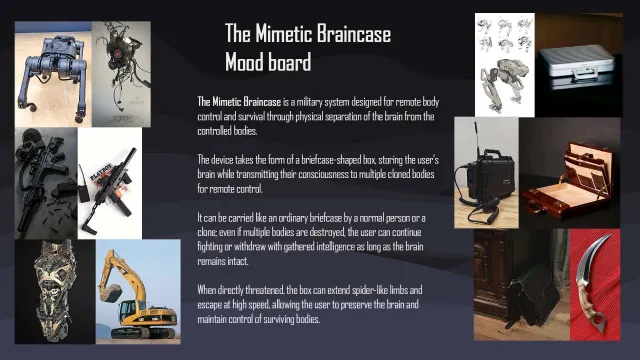
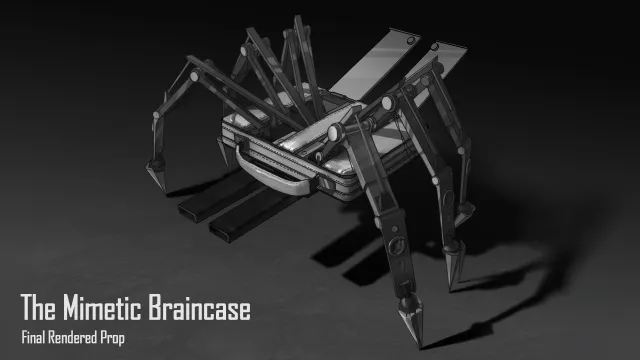
The Mimetic Braincase is an enemy I designed for my original series, The Star of Embarkation. Its brain resides inside a mechanical container disguised as a suitcase. The hidden controller can operate multiple clones at once, using their coordinated actions while keeping its actual body concealed and mobile outside the immediate fight.
Setting: The Legacy
The Star of Embarkation takes place after humanity escapes a collapsing Earth aboard the Embarkation Vessel and reaches an unfamiliar planet. The vessel crashes during landing, leaving behind advanced equipment and wreckage from Earth. These technological remnants are known as the Legacy. They cannot be manufactured or replicated on the new world, making them extremely valuable. The planet's native Fiber also suppresses conventional electrical and thermal technology; many Legacy devices remain unaffected, making them especially important.
The Mimetic Braincase combines Legacy technology with human augmentation. It uses this irreplaceable technology to house a transplanted human brain in a suitcase-shaped mechanical container and control cloned bodies through neural interfaces.
Prop Design and Rendering
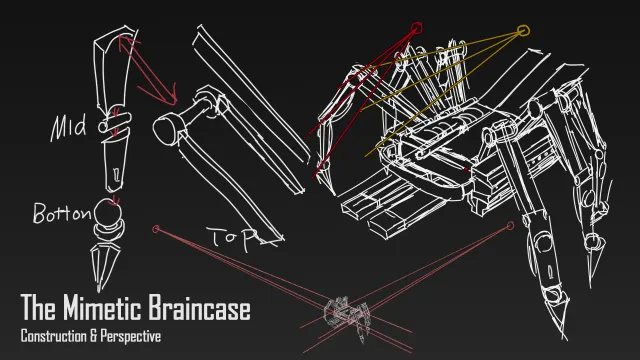
For the course prop project, I chose this mechanically complex enemy from The Star of Embarkation to practice rendering different geometric forms and materials. Its design includes mechanical arms, a leather suitcase, and two gun barrels under the case. I focused on the metallic finish of the arms, the leather texture of the case, and the metal of the gun barrels, while trying to make the mechanical connections plausible.
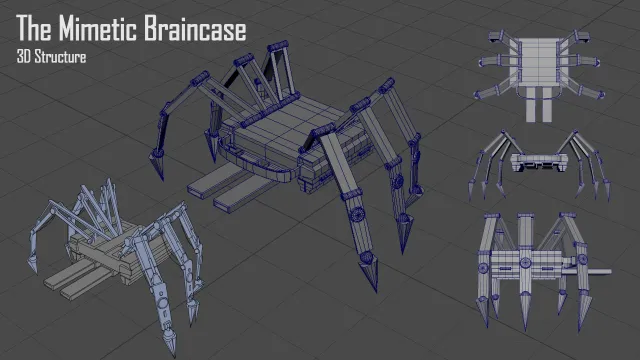
The original sketch contained so many connected parts that keeping the perspective accurate became difficult. I built a simplified model in Maya to establish the component positions and perspective, then used it as reference for the final two-dimensional painting. The shadows also drew on the three-dimensional model and were rendered in Photoshop. This workflow helped me maintain the structure while concentrating on different material qualities.
The Brain and Its Clones
I took inspiration from the hive structure in Ender's Game: as long as the hidden controller survives, it can continue operating other bodies.
Neural interfaces can be implanted in different locations, including both the brain and spinal cord of the same clone. Even if a clone suffers an otherwise fatal head injury, the controller can continue directing its movements through the spinal interface. One controller can command several clones simultaneously, coordinating them in combat and effectively forming an army of one. If a clone dies, its controller still receives the information that clone acquired. This makes the system valuable for both combat and intelligence gathering.
Concealment and Connection Limits
The brain container is disguised as an ordinary suitcase that a clone can carry. Concealed mechanical legs allow it to move at high speed like a spider. Because of this mobility, the small container can conceal itself underground, in grass, or high in trees, far from the center of a fight. In a complex environment, a searcher would find it almost impossible to locate without a way to determine its position first.
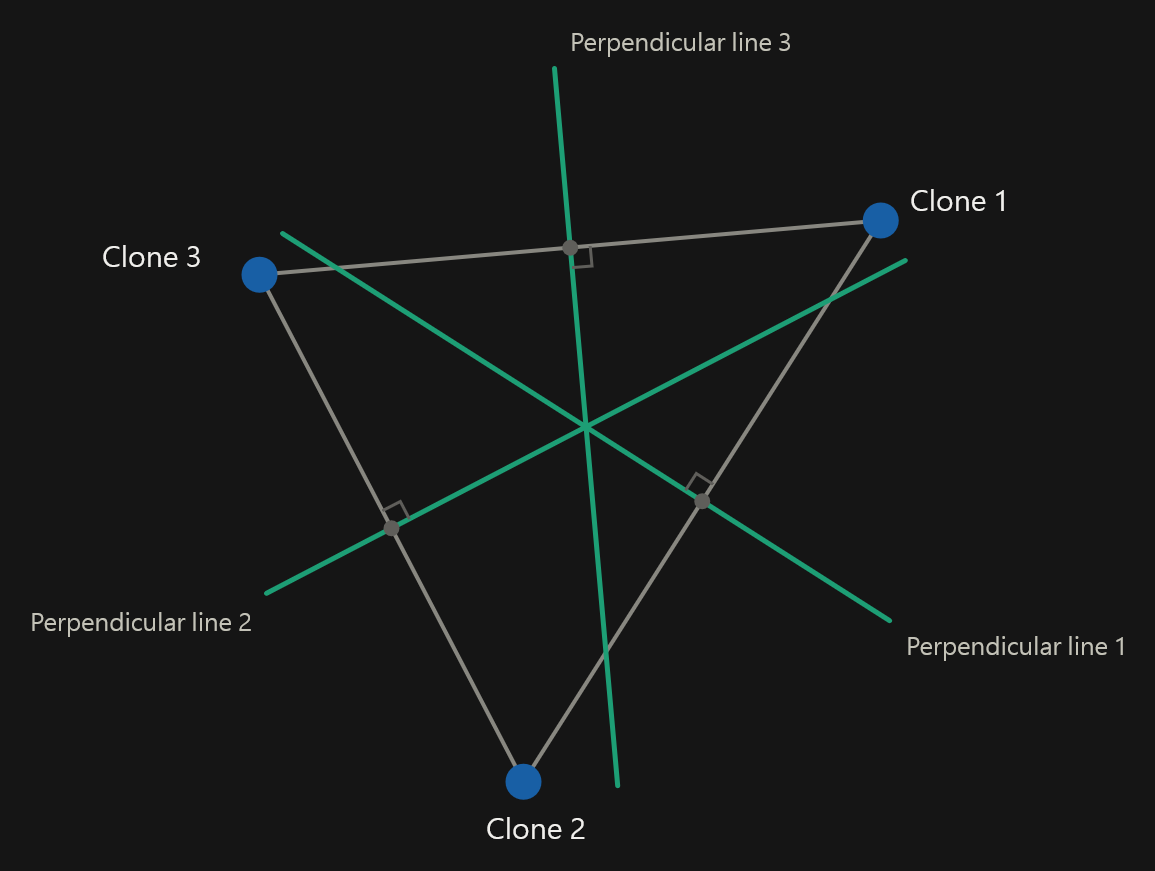
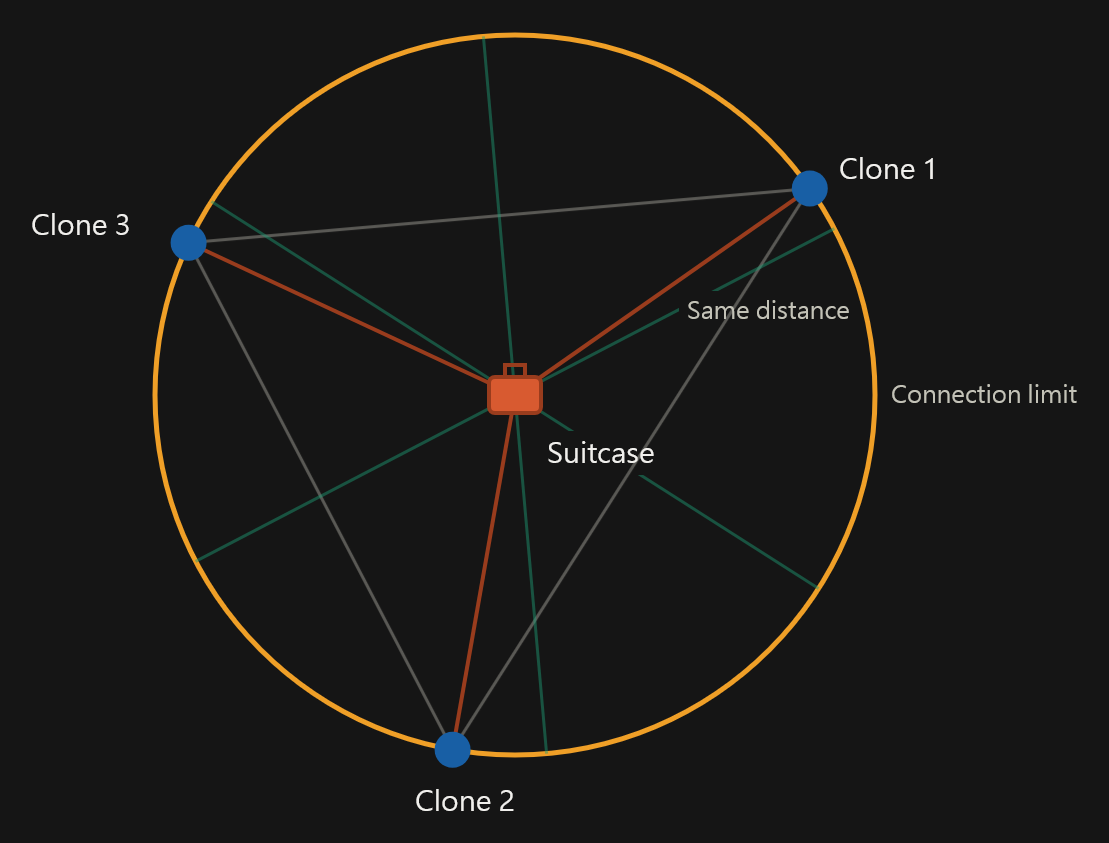
All clones must remain connected within a limited circular range centered on the suitcase to keep moving. For protection against hacking, a disconnected clone cannot reconnect by itself. The controller is highly capable of hiding and escape, but it also needs to keep its valuable clones inside that connection radius.
The clones attack and gather intelligence while the controller remains hidden outside the battlefield. Their need to stay connected provides a way to infer its location.
Combat Design: Locating the Hidden Controller
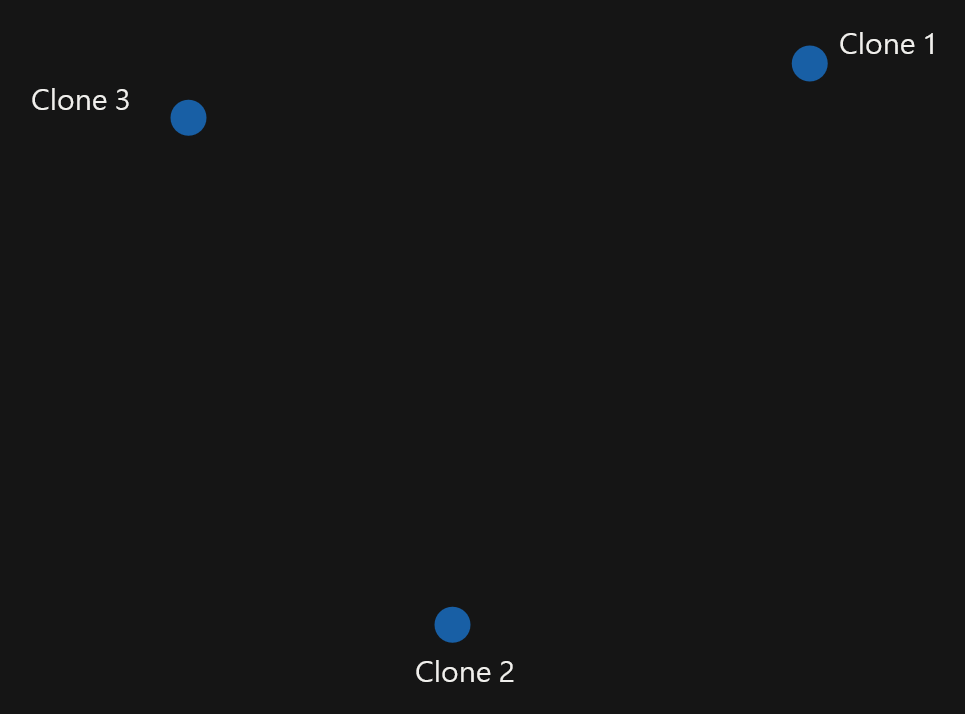
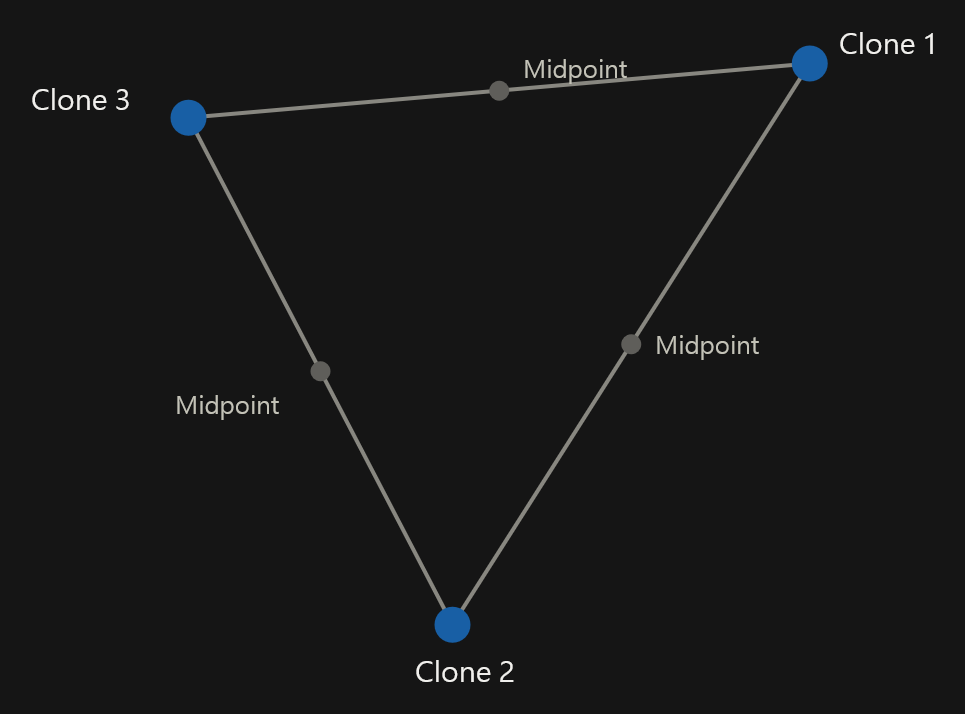
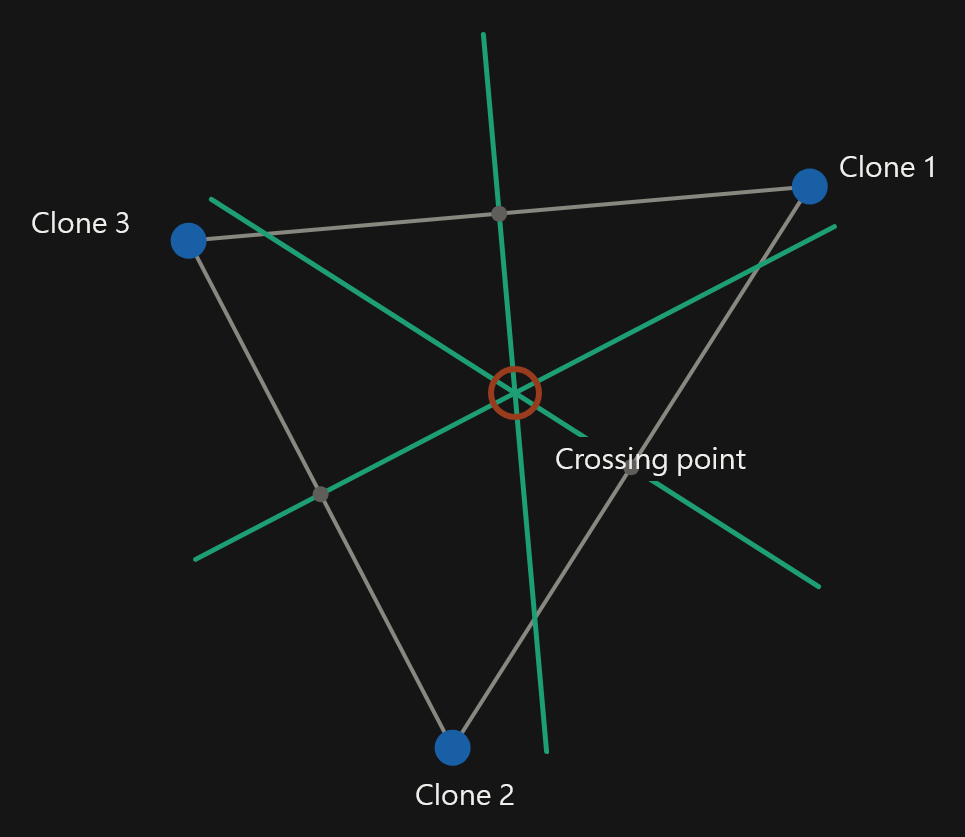
The searcher must first recognize that multiple clones are being controlled by a single hidden entity. Their movements can then reveal a limit to their operating range. Discovering the boundary alone does not reveal the radius or the center of that circle. I illustrated a geometric way to infer the suitcase's position in five diagrams.
Course work: prop design and painting process: